I've Seen This Movie Before
A CTO reaches out. They've got a Series B under their belt, 80 employees, and a procurement team at their biggest prospect that won't move forward without a SOC 2 report. The conversation always starts the same way: "We're thinking about hiring a compliance person."
I get it. It feels like the responsible move. You have a problem, so you hire someone to own it. That's how you've solved every other growing pain.
But compliance is different, and I've watched enough companies learn this the hard way that I feel obligated to be direct about it: your first compliance hire probably shouldn't be an employee.
The Numbers Are Brutal
Let's just do the math. A compliance manager with enough experience to actually build a program from scratch runs $150K to $250K in total comp. Compliance tooling is another $20K to $60K a year. Your first SOC 2 audit is $30K to $80K. You're north of $250K before the program produces a single deliverable.
For a 50-person SaaS company, that's a big number. And here's the part nobody talks about in the interview process: the work is unpredictable. One week you're deep in audit prep. The next week it's a 400-question security questionnaire from your biggest prospect. Then a vendor risk assessment lands, then an incident response plan needs updating, then the board wants a security update. A single hire can't cover that breadth, so they either become a bottleneck or they get pulled into IT ops and vendor management to fill the gaps. Either way, the program suffers.
The Experience Problem Is Worse Than the Cost Problem
Here's what keeps me up at night about the "just hire someone" approach.
Building a compliance program requires a very specific blend of skills. You need someone who understands cloud infrastructure and CI/CD pipelines. Someone who can translate your actual technical environment into controls that satisfy ISO 27001 or SOC 2. Someone who can talk to your engineers without condescending and talk to your board without losing them.
That person exists. They're also fielding offers from companies twice your size with established teams and bigger budgets.
The candidates in your budget often have narrower experience. They've managed an existing program, but they've never built one. They know one framework well, but when your European prospects start asking about ISO 27001 and GDPR alongside SOC 2, or your product team needs guidance on AI governance requirements, they're figuring it out for the first time on your dime.
I had a company come to us after their first compliance hire spent six months and still hadn't produced a readiness assessment. The person wasn't bad at their job. They just hadn't done it before, and there was nobody in the building to show them what "good" looks like. That's not a people problem. That's a structural one.
What This Actually Looks Like When You Outsource It
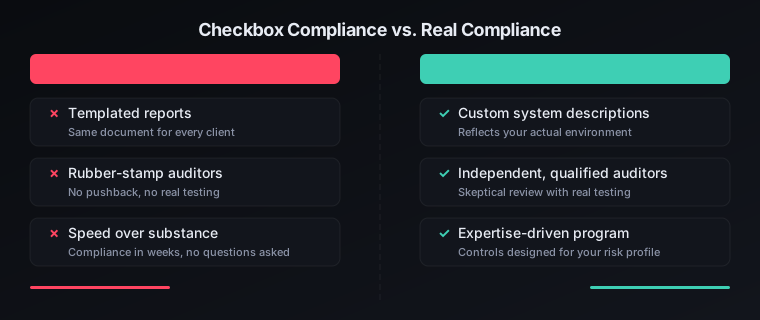
I want to be clear: I'm not talking about hiring a consultant to hand you a binder of policy templates and wish you luck. That model is broken and everyone knows it.
What I'm talking about is a team that operates as your compliance function. They're in your Slack. They're on your calls. They own the program the same way an internal team would, but you're getting the collective experience of people who have built and managed this across dozens of companies.
In practice, that means:
They build the program. Scope, framework selection, control design, the whole thing. And because they've done it before (a lot), they know what works for SaaS companies at your stage and what's overkill.
They run your audit. Auditor selection, evidence prep, managing the back-and-forth. First audits are where things go sideways most often, and having someone in the room who's done 50 of these is a completely different experience than figuring it out together for the first time.
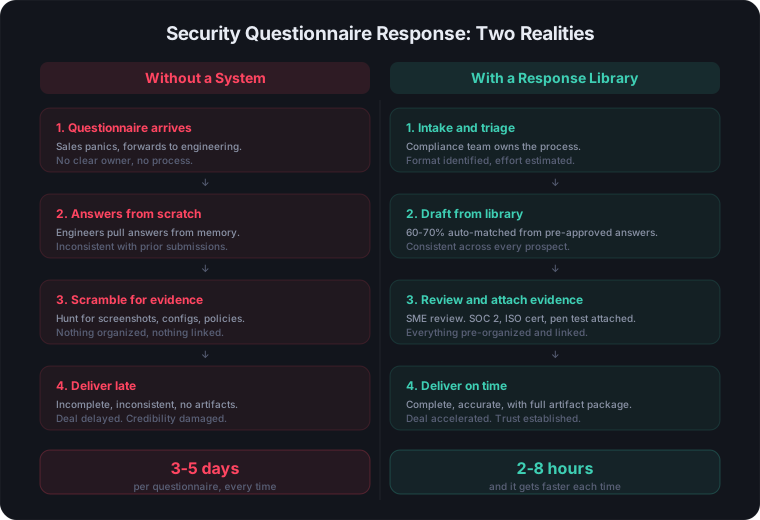
They handle the questionnaires. If you've ever watched your VP of Engineering spend three days answering a 400-question security questionnaire, you know how painful this is. An outsourced team handles these directly, with the authority and specificity that enterprise procurement teams expect.
They keep it running. Compliance doesn't end after the audit. Evidence collection, policy updates, control monitoring, prep for next year. This is the part that kills internal hires through burnout or boredom, but it's just Tuesday for a managed team.
One Person vs. a Team
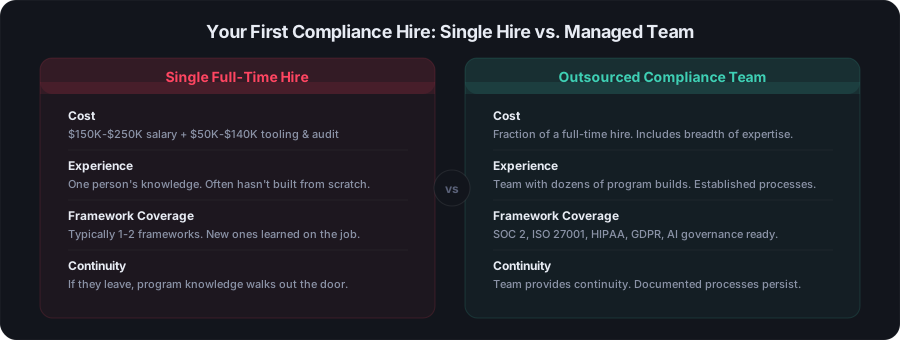
Think about what you're actually buying with a single hire. One person's experience. One person's framework knowledge. One person's auditor relationships. If they leave, your entire program knowledge walks out the door.
With an outsourced function, you get a team. Collective experience across SOC 2, ISO 27001, HIPAA, GDPR, and more. If one practitioner is out, the team has continuity. When you need to add a new framework, the expertise is already there. And the cost is a fraction of that single senior hire.
I'm biased here, obviously. This is what Concerto does. But I'm biased because I've been on both sides of this. I've been the auditor. I've been the consultant handing over the binder. And I've seen what works. Teams that outsource their first compliance function get to audit-ready faster, spend less, and end up with better programs.
When Does It Make Sense to Hire In-House?
This isn't a "never hire" argument. There's an inflection point.
When you're managing four or more frameworks, when your headcount passes 200 to 300, when compliance requirements are shaping product decisions daily and not just quarterly: that's when adding dedicated internal headcount starts to make sense. But even then, most of the companies we work with at that scale still keep us involved. The internal hire owns the day-to-day. We stay on for the strategic layer: multi-framework coordination, audit management, and the specialized expertise that doesn't make sense to staff for full-time.
And here's the thing, the transition is so much smoother when you've had a managed team running the program first. Your first internal hire inherits documented processes, established auditor relationships, and evidence collection workflows that actually work. They're stepping into a functioning program instead of starting from scratch. We've even helped clients write the job description and evaluate candidates when they hit that point.
The Real Cost of Waiting
I'll leave you with this. The most expensive compliance decision isn't which tool to buy or which framework to pursue first. It's how long you take to get credible.
Every month without a program is another deal where procurement gets "we're working on it" instead of a SOC 2 report. Another security questionnaire where your engineering team scrambles to give answers that sound confident but aren't backed by anything. Another quarter where compliance feels like something that's getting in the way instead of something that's opening doors.
If that sounds familiar, let's talk about it. I promise the conversation is more fun than reading a job description for a compliance manager.