The Multi-Framework Reality
It starts with SOC 2. A key prospect won’t sign without it. So you build a compliance program, go through the audit, and get your report. Done.
Then another customer needs ISO 27001. A healthcare partner requires HIPAA assurances. A European expansion brings GDPR into scope. And suddenly you’re managing four compliance frameworks with overlapping (but not identical) requirements.
This is the reality for most growing SaaS companies. And the companies that treat each framework as a separate project end up with redundant controls, duplicated evidence, and a compliance function that consumes disproportionate resources.
There’s a better way.
The Control Mapping Approach
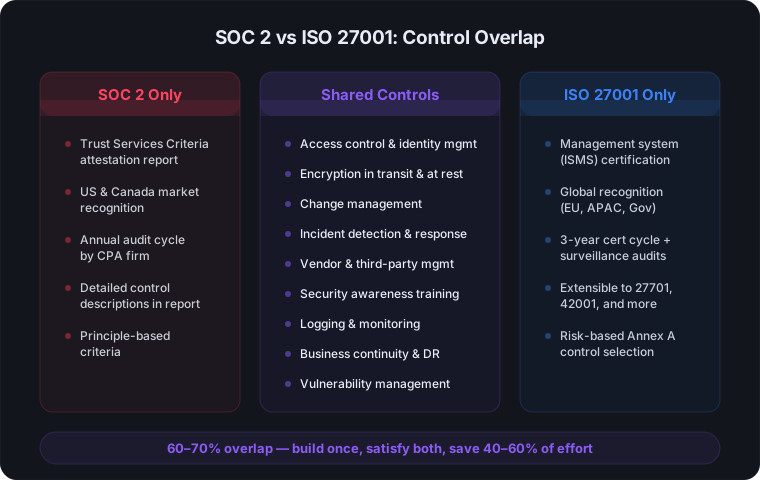
The foundational insight is that compliance frameworks overlap significantly. SOC 2’s Common Criteria and ISO 27001’s Annex A controls cover much of the same territory: access control, change management, incident response, risk management, vendor oversight. The specific language and structure differ, but the underlying control objectives are remarkably similar.
A well-designed control mapping identifies these overlaps and creates a unified control set where a single control implementation satisfies requirements across multiple frameworks simultaneously.
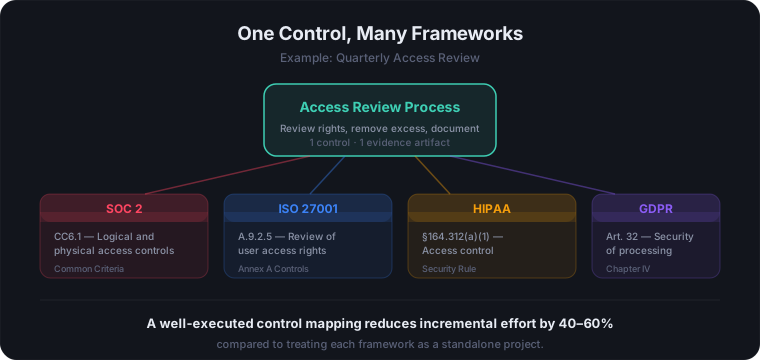
For example, your access review process (quarterly review of user access rights, removal of excessive privileges, documentation of review completion) can simultaneously satisfy:
- SOC 2 CC6.1: Logical and physical access controls
- ISO 27001 A.9.2.5: Review of user access rights
- HIPAA §164.312(a)(1): Access control
- GDPR Art. 32: Security of processing
One control. One piece of evidence. Four frameworks satisfied.
In our experience, a well-executed control mapping reduces the incremental effort of adding a new framework by 40-60% compared to treating it as a standalone project.
Building the Unified Evidence Repository
Control mapping is only half the equation. The other half is evidence management.
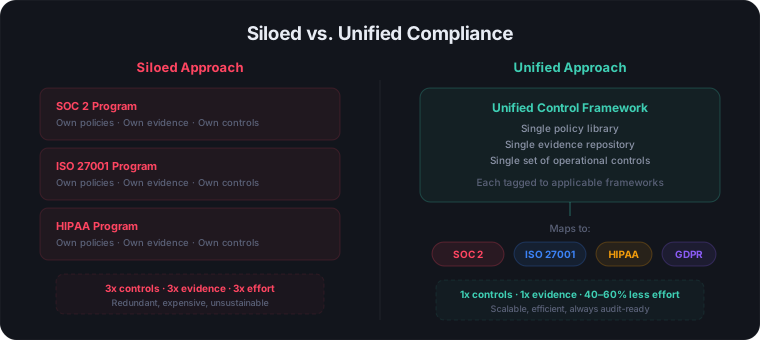
Every compliance framework requires evidence that controls are designed and operating effectively. The mistake most organizations make is collecting evidence separately for each framework: one folder for SOC 2 evidence, another for ISO 27001, a spreadsheet tracking HIPAA documentation. This creates redundancy, version control nightmares, and audit preparation chaos.
Instead, build a single evidence repository organized by control, not by framework. Each piece of evidence is tagged with the frameworks and specific requirements it satisfies. When audit season arrives (and with multiple frameworks, there’s always an audit somewhere on the horizon), you pull evidence by framework tag rather than hunting through siloed folders.
This approach requires upfront investment in evidence taxonomy and tagging, but it pays dividends immediately:
- No duplicate evidence collection. You collect it once, map it many times.
- Always audit-ready. Evidence is continuously organized, not scrambled together before each audit.
- Clear gap visibility. You can instantly see which controls have evidence gaps and which frameworks are affected.
Sequencing Your Frameworks
When adding a new framework, sequence matters. Here’s the approach we recommend:
Start with your broadest framework
SOC 2 or ISO 27001 typically provides the broadest control coverage. Build your core program around one of these, then layer additional frameworks on top.
Conduct an incremental gap analysis
Don’t start from scratch with each new framework. Assess your existing controls against the new framework’s requirements and identify only the incremental gaps, the requirements that aren’t already satisfied by your existing control set.
Prioritize by customer demand
If a healthcare customer needs HIPAA and a European customer needs GDPR, prioritize based on revenue impact and contract timelines, not framework complexity.
Align audit schedules where possible
If you can align your SOC 2 audit period with your ISO 27001 surveillance audit, you reduce the total evidence collection burden and auditor coordination overhead. Some audit firms offer combined audit engagements that further reduce cost and disruption.
Common Multi-Framework Mistakes
Treating each framework as a separate program. This is the most expensive mistake. It leads to separate control inventories, separate evidence repositories, and separate compliance workflows. Build one program, map to many frameworks.
Over-customizing controls per framework. A control that satisfies ISO 27001 A.9.2.5 almost certainly satisfies SOC 2 CC6.1 as well. Don’t create framework-specific versions of the same control. Maintain one control with multiple framework mappings.
Ignoring the management system. ISO 27001 requires a formal management system (ISMS). Rather than treating this as an ISO-specific overhead, use it as the governance structure for your entire compliance program, including SOC 2, HIPAA, and GDPR. The management review, internal audit, and continuous improvement processes benefit every framework.
Not investing in tooling. Managing multi-framework compliance in spreadsheets works for one framework. It becomes unsustainable at two. By three, it’s actively harmful. Invest in GRC tooling that supports control mapping, automated evidence collection, and multi-framework reporting.
How We Approach Multi-Framework Engagements
At Concerto, multi-framework management is core to how we operate. Every VCM engagement starts with a unified control framework that maps to all of a client’s target standards. We build one evidence repository, one policy library, and one set of operational procedures, then tag everything to the applicable frameworks.
When a client adds a new framework, we conduct an incremental gap analysis, extend the control mappings, and update the evidence collection, without rebuilding from scratch. This is how we keep our clients’ compliance programs efficient and sustainable as their regulatory obligations grow.
If you’re managing (or about to manage) multiple compliance frameworks, schedule a consultation to discuss how a unified approach can save you time, money, and sanity.
Want to see how SOC 2, ISO 27001, HIPAA, PCI DSS, and GDPR overlap? Try our Compliance Framework Navigator to compare control areas across frameworks.