First, Congratulations
If you're staring at a year where a SOC 2 renewal overlaps with a first ISO 27001 certification, or a PCI DSS scope expansion lands on top of your annual SOC 2, I want to start by saying the quiet part out loud: this is good news.
Nobody adds audits for fun. You're here because you closed bigger deals, moved upmarket, or expanded into a market with its own rules. Compliance scope follows revenue. The companies juggling three frameworks at once are usually the ones winning, not the ones drowning.
So the problem in front of you isn't strategic. You already know why you're doing this. The problem is operational, and it's a real one: you have a small internal team, three audit cycles want a piece of them in the same six months, and there are only so many weeks in a quarter. Get the operations wrong and you don't fail the audits. You just grind your best people into the ground getting through them. Then they leave, and now your compliance program has a continuity problem on top of a calendar problem.
Let's talk about how concurrent audits actually go sideways, and then how to keep them from doing that.
How Concurrent Audits Go Sideways
I've watched this play out enough times that the failure modes are predictable. None of them are about the frameworks being hard. They're about coordination that nobody owned.
The same evidence, requested three different ways. Your SOC 2 auditor wants your Q2 access reviews. Your ISO auditor wants evidence for A.5.18. Your PCI assessor wants your Requirement 7 access control records. These are the same thing. Your access review process satisfies all three. But if each request lands in a different inbox, in a slightly different format, with a different due date, the same engineer pulls the same report three times and reformats it three times. Multiply that across dozens of overlapping controls and you've doubled or tripled the workload for no reason other than that nobody connected the requests.
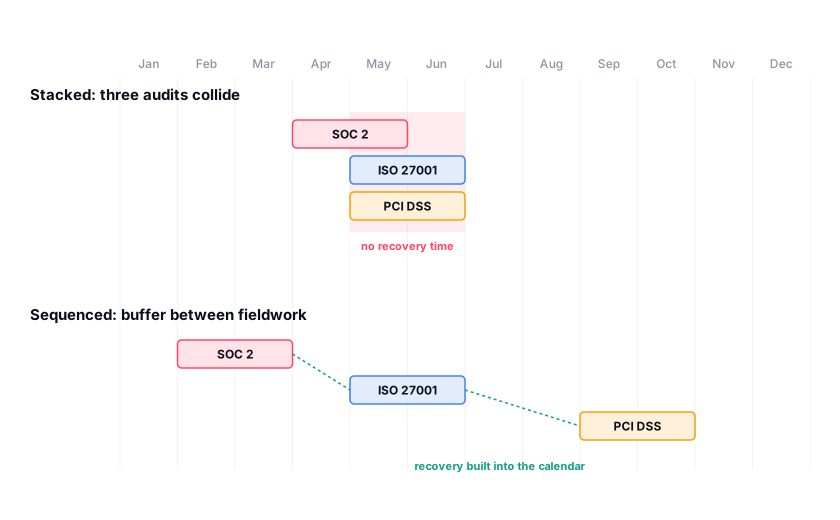
Calendar collisions with no recovery time. Fieldwork is intense. Auditors are in your systems, asking follow-ups, pulling your people into walkthroughs. One fieldwork week is survivable. Three fieldwork weeks stacked back to back, or worse, overlapping, means your engineering team spends a month context-switching between auditors instead of building your product. There's no decompression. By the time the third assessor wraps, your team is fried and you've got another renewal cycle starting in a few months.
No single owner driving the program. This is the big one. When each audit runs on its own track, each assessor relationship is managed by whoever happened to pick up that engagement. The SOC 2 auditor talks to your security lead. The ISO auditor talks to your IT manager. The QSA talks to whoever owns the cardholder data environment. Nobody has the full picture, nobody catches the duplicate requests, and nobody has the authority to tell an assessor "we already provided that, here it is, please reference it." Three relationships, zero coordination.
Treating each audit as a project instead of a program. A project has a start, an end, and a finish line you sprint toward. An audit feels like that, which is exactly the trap. When you treat each audit as its own project, you spin up evidence collection from scratch, scramble to the deadline, exhale, and then do the whole thing again for the next framework two months later. The work never compounds. You're paying the setup cost over and over for what should be one continuous operation.
How to Run Them Well
Here's the good news. Every one of those failure modes has a fix, and the fixes reinforce each other. Notice that almost none of them is a scheduling trick. Most of the work sits upstream of the calendar.
Make evidence an output of the program, not a project for the audit
Start here, because it reframes everything else. The goal isn't to assemble an evidence package every time an auditor shows up. The goal is a GRC program healthy enough that evidence is simply a byproduct of running it.
In a functioning program, the controls run on their own cadence, independent of any audit. Access reviews happen quarterly because that's the control, not because an assessor is coming. Change management is captured as part of how you ship. Vendor reviews, access provisioning, incident retros: all of it generates artifacts continuously, as a natural output of the work. When that's true, evidence collection stops being a phase you brace for and becomes an export you run.
I won't pretend you can flip this on in the middle of a crunch. A program reaches this state over a cycle or two, usually with automation handling the continuous collection so artifacts accumulate on their own instead of someone screenshotting consoles the week before fieldwork. But it's the direction every other decision on this list should point, because it's the only one that actually scales. Teams burn out when every audit means manufacturing evidence after the fact, under deadline, for controls that weren't really operating until someone asked. Teams coast through three concurrent audits when the evidence already exists because the program genuinely runs the rest of the year.
Map the evidence once, across every framework
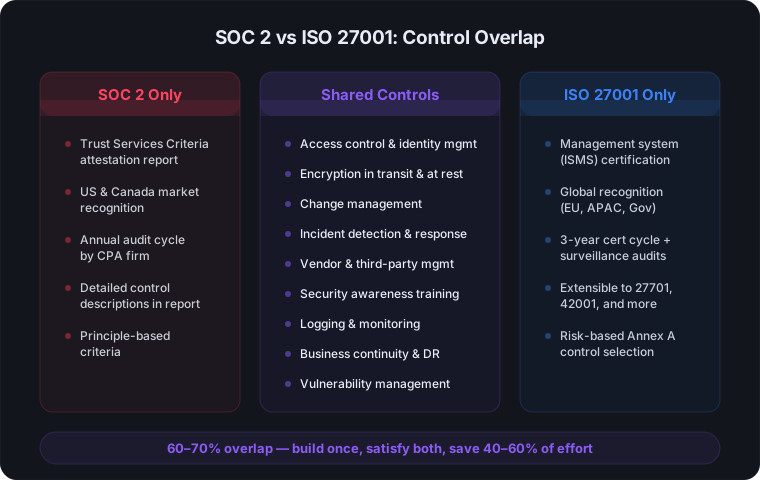
Once your controls are producing artifacts, the job is to not collect them three times. This is the principle behind any multi-framework compliance strategy: the frameworks overlap far more than they differ. SOC 2's Common Criteria, ISO 27001's Annex A, and PCI's requirements are three vocabularies for a lot of the same controls. Access reviews, change management, logging, vendor oversight, incident response.
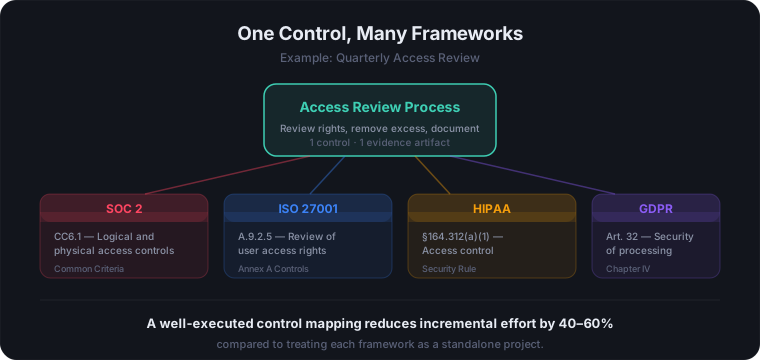
So build the mapping layer, not a pile of duplicate folders. One access review record, tagged to every framework and control it satisfies, pulled by tag when each assessor asks. The library isn't something you rebuild per audit. It's the index that points each assessor at the artifact your program already produced.
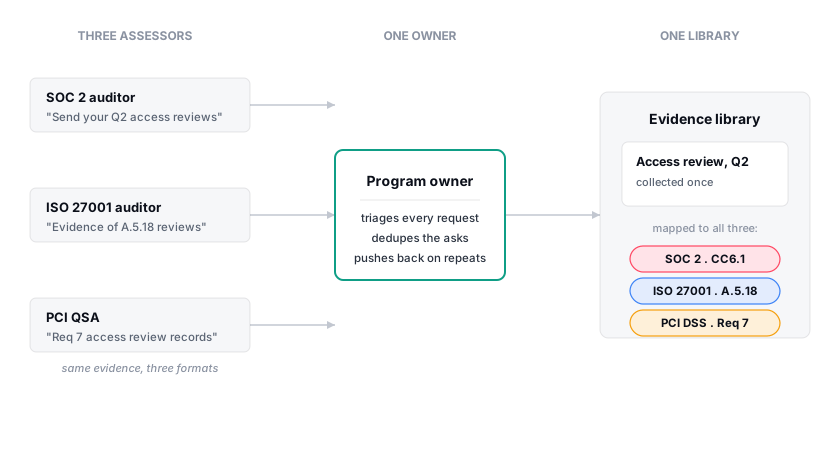
One access review, mapped to SOC 2 CC6.1, ISO 27001 A.5.18, and PCI Requirement 7, collected once. That's an engineer pulling a report a single time instead of three, multiplied across dozens of overlapping controls.
Shrink the audit surface before you coordinate it
Here's the lever almost nobody reaches for first, and it beats every coordination trick on this page: audit less. Before you optimize how you run three assessments, ask whether all three need to be as big as they are. Every system, team, and criterion you keep out of scope is evidence you never collect and a person who never gets pulled into a walkthrough.
You have more say over scope than the frameworks make it feel like:
- PCI scope is a design decision. Segmentation, tokenization, and pushing the cardholder data environment onto a compliant provider can lift whole systems, and the engineers who run them, out of scope entirely. A well-segmented PCI assessment can be a fraction of the evidence and fieldwork of a flat-network one. This is often the single biggest burnout reducer available, and it's an architecture conversation, not a compliance one.
- SOC 2 criteria are a menu. Security is required. Availability, Confidentiality, Processing Integrity, and Privacy are not. Don't carry criteria a customer never asked for because they came bundled in a template.
- ISO scope is a sentence you write. The ISMS scope statement defines which sites, systems, and services the auditor examines. Draw it tightly and deliberately. An over-broad scope means more controls, more evidence, and more interviews for no commercial benefit.
The discipline is to scope to what your customers and regulators actually require, and not one system more. One caution: don't descope the thing the deal depends on. Carving out work that a prospect's security review will demand anyway doesn't save effort, it just moves the pain to a worse moment.
Give one person the authority to run the whole thing
Assign a single owner across all the audits. Not three coordinators, one. And give them real authority, because the job isn't scheduling. It's triaging requests across audits, catching when two assessors ask for the same evidence, and pushing back on the duplicates. "We provided this for the SOC 2 engagement, it's the same control, here's the reference" is a sentence that saves your team hours, and someone has to be empowered to say it.
This person is also the single face to every assessor. One relationship manager, however many audits. They see the whole board, so they catch the collisions before your engineers feel them.
Push for one unified audit off a single document request list
Everything above fixes duplication on your side of the table. There's a move that fixes it on the assessor's side too, and it's the most underused lever I see: have one firm assess everything at once, off a single document request list. Three separate firms means three DRLs in three formats, three fieldwork windows, and three sets of walkthroughs over the same controls. A firm that runs an integrated engagement collapses that into one DRL, one project plan, one window. Your team answers each question once instead of fielding the same ask from three directions.
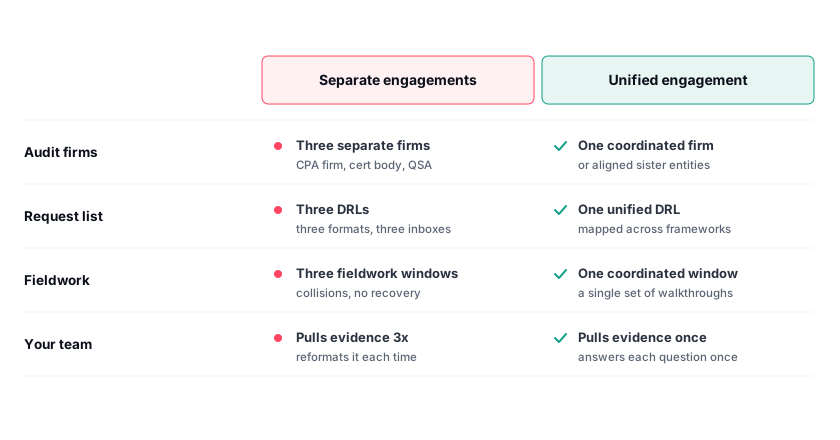
Two honest caveats. First, the accreditations are real. SOC 2 has to be issued by a licensed CPA firm, an ISO 27001 certificate has to come from an accredited certification body, and PCI, at the level that needs a Report on Compliance, requires a QSA (smaller scopes self-assess with an SAQ and no QSA at all). One legal entity rarely holds all three, so "single firm does everything" is less common than the brochures imply. What you actually want is a firm that delivers a coordinated engagement, often through aligned sister entities or a tight partnership, under one DRL and one project plan. Ask the question directly when you're choosing your auditors: "Can you issue one integrated document request list across all three frameworks and run fieldwork in a single coordinated window?"
Second, a unified window is less total work but a higher peak. All the walkthroughs and follow-ups land in the same two weeks, so plan your team's load around that concentrated push instead of assuming "one audit" means "easy." Even with that tradeoff, a unified DRL is worth more than squeezing the last few percent of price out of splitting the work across firms. Independence, quality, and fit still come first, and I wouldn't leave a great auditor just to consolidate. But if you can get it, take it.
Sequence fieldwork with buffer, even if you have to negotiate for it
If you can't consolidate, the calendar becomes your lever. Assessors have more flexible dates than you'd think; the windows that landed on your calendar are usually a default, not a constraint. Push on them. If your SOC 2 fieldwork wants the same two weeks as your ISO Stage 2, ask one of them to move. Put real space between fieldwork weeks so your team recovers and refocuses before the next assessor shows up.
One caveat from experience: ISO surveillance and recertification dates are tethered to your certification anniversary and can't slide freely, so build the rest of the calendar around the dates you can't move. Buffer isn't a luxury. It's what keeps people functional across a long year. Three windows spread across Q1, Q2, and Q3 is a completely different experience from the same work crammed into one brutal six weeks, even though the total effort is identical.
Protect the load-bearing deadline
This is the judgment call that separates a managed program from a fire drill. Not every deadline carries the same weight, and fewer of them are truly movable than people hope. An ISO recertification can't lapse without losing the certificate. A SOC 2 with a contractual date tied to your biggest customer is fixed. So when the calendar tightens, get clear-eyed about which deadline is genuinely load-bearing and which one (a surveillance audit with some give, an internal target) can move a few weeks without consequence. Protecting the critical one is worth slipping the one nobody's renewal hinges on. Trying to hit every date perfectly is how you miss the one that actually mattered. It's also the best argument for building buffer early, while the dates are still negotiable.
When an Outside Partner Helps, and When It Doesn't
I run a firm that does this work, so you'd expect me to tell you to outsource it. I'm going to be more honest than that, because the wrong answer here is genuinely expensive.
The distinction that matters isn't internal versus external. It's whether the program is genuinely owned and operated, versus treated as a side project nobody really drives. A partner earns its keep in two very different situations, and the trap is the same in both.
If you already have a strong internal team that's simply stretched, a partner adds coordination capacity. Your people know your environment, your controls are real, the program functions. You just cannot physically absorb three audit cycles in one year on top of the day job. We run the assessor relationships, sequence the calendar, and take the duplicate-request triage off your team's plate so they stay focused on the parts only they can do.
If you don't have an internal owner at all, the answer isn't "hire someone first, then outsource." This is exactly where an outsourced team is the right first move, because the right partner doesn't hand you a binder and wish you luck. They operate as your compliance function. They own the program, run it year-round, and stand up the healthy operating cadence that makes evidence an output rather than a fire drill. That's the case for your first compliance "hire" being an outsourced team, and concurrent audits are precisely the pressure that exposes whether you have a real owner or not.
So the thing to watch for isn't the org chart. It's the engagement model. A partner that truly runs the program, in your Slack, on your calls, accountable for outcomes, works whether you have an internal team or none. A partner that drops policy templates and disappears leaves you to face three audits alone, which is the worst version of all of this. Owned and operated beats outsourced-and-abandoned every time.
If the Math Isn't Working
So here's where I'll leave it. If you're mapping out your audit calendar for the year and the weeks just don't add up, if you're looking at three fieldwork windows and a team that's already at capacity and the spreadsheet keeps coming up short, that's worth a conversation before it becomes a crisis.
We're happy to walk through your calendar with you. Bring the frameworks, the dates, and an honest read on your team's bandwidth, and let's figure out whether the math works. Sometimes the answer is a tighter scope and a healthier evidence cadence, and you've got it handled. Sometimes it's that you need an extra set of hands for one stretched year. Either way, you'll know before fieldwork starts instead of finding out in the middle of it.